skip to main |
skip to sidebar
Posted by
Unknown
at
10:34
I'm watching a sermon from John MacArthur from this week's Master's College conference. It is titled "THE WORD OF GOD: THE DIVINE REVELATION TO MAN - TRUTH all provided by vicarious, substitutionary sacrificial death of a divinely chosen acceptable lamb who bears all the sins of His people by taking on himself willingly the full weight of divine punishment. It sounds like Romans in the NT. It looks like it is completely out of place."
Now, get this. He said,
"Isaiah is 66 books. It is divided the same way the bible: 39 chapters and 27 chapters. The first 39 are about judgment. The next 27 are about salvation."
"Of the last 27 about salvation, the first 9 have to do with the salvation of the nation Israel. The last 9 have to do with the salvation of the earth. The middle 9 have to do with the salvation of the soul."
"If you go to the middle of the middle 9, you get to chapter 53, and if you go to the middle of 52:12-53 you come down to verses 4,5. and 6, "He was wounded for our transgressions."The bible is a wondrous book. John 10:35 says, "if he called them gods to whom the word of God came-and Scripture cannot be broken-"
Scripture cannot be broken. It is uttered from the mouth of God through His Holy Spirit and His Son. It is easier for the world to pass away than for one jot or tittle of scripture to pass away (Matthew 5:18).
It is tightly woven tapestry that is perfect. The Law is perfect (James 1:25; Psalm 19:7). His works are perfect (Deuteronomy 32:4). Psalm 18:30 says His way is blameless. His way is perfect and His word is perfect! (2 Samuel 22:31).
Once someone said to me, "I just take a lot of the Old Testament with a grain of salt." This bothered me then and it bothers me now. You cannot take one jot or tittle away from His word and expect that the tapestry will remain woven.
Revelation 22:18-19 says "I warn everyone who hears the words of the prophecy of this book: if anyone adds to them, God will add to him the plagues described in this book, and if anyone takes away from the words of the book of this prophecy, God will take away his share in the tree of life and in the holy city, which are described in this book."
Woe to those who say "I HAVE A WORD FROM THE LORD AND I AM HERE TO TEACH IT TO YOU." No one can add to His word. WOE TO THOSE who take away from His word by claiming some part is untrue and it doesn't mean what it says it means.
It is all perfect and true. If you start picking threads out that are true and not true, or to believe or not believe, and it becomes YOU who are broken, for the scripture cannot be broken. It is perfect!
What is the point here? Read your bible. It is really good!
Source: 33witches.blogspot.com
Posted by
Unknown
at
17:22
*
When I became a Christian I was soon very confused indeed about the central place of the c. 150 Psalms in worship.
Why on earth should these apparently "pre"-Christian, ancient Jewish, poems or songs take-up such a very large amount of Christian worship?
*
Why, indeed, did Psalms apparently constitute "almost the whole of Christian worship" in ancient times?
(Especially before there were any Christian scriptures, but even much later. Some of the most devout and spiritually advanced Saints seemed barely to read the New Testament: knowing the basic Gospel story plus praying the Psalms seemed to be almost their whole devotional life.).
*
Why did some ancient monks sing them eight times a day, some modern monks four times a day, and even ordinary Anglicans twice a day?
Why are priests supposed to read the Psalms once a month, why are monks supposed to chant all of the Psalter "every week for their whole lives"?
Why did so many people in the past learn the Psalms by heart?
*
The first thing I did was to read C.S Lewis's "Reflections on the Psalms".
Lewis, in this book, is at his most Protestant and least Catholic - and he firmly regards the Psalms as a record of ancient Jewish hymns by diverse hands, to be interpreted in their historical context; and at most providing reminders and correctives of specifically Christian ideals.
He did indeed alert me to many good things about the psalms - but the answers he gave did not even "begin "to explain why, much less to justify, the psalms should have taken up "so much "time and effort from Christians for at least three-quarters of the span of Christianity.
Even if everything positive which Lewis has to say about the Psalms was absolutely correct and that to the fullest degree - then the implication is that "surely "(if that is all there is to them) Christians could find something "better" to focus upon - something actually Christian?
*
The answer, I later discovered, is that traditionally Christians have regarded the Psalms as (in essence) a "part of the New Testament", being uttered "by and about Christ".
This is, of course, the original Orthodox and Catholic way of reading the Psalms, and the way which persisted over many, many centuries.
In a nutshell, the Psalms were always regarded as prophetic utterances; divinely inspired among the ancient Jews but revealing their true meaning only after the incarnation, crucifixion and resurrection of Jesus.
*
Lewis swiftly disposes of this in a chapter on Second Meanings, and seems to conclude that this effect is only apparent; mostly merely a "reminder "of what happened some hundreds of years after the Psalms were composed.
Thus I have come to regard Lewis's book on the Psalms - for all its good nuggets - as perhaps his only fundamentally "mistaken" book - the only one in which he reasons like a modern Biblical scholar instead of forming a bridge to pre-modern wisdom.
Yet Lewis's actual practice was wiser than his understanding - he prayed the Psalms, frequently; he knew them by heart.
In sum, Lewis actually did, 'despite' all the reasons he gives "which imply that it is not worth doing this", learn, read and speak the Psalms through - many, many times - for his whole adult life.
And there is a lesson in "that".
*
Source: masonsofheaven.blogspot.com
Posted by
Unknown
at
23:25
Have you ever thought why monasteries around the world have a strict schedule of prayer? Besides the fact that they are following an ancient tradition of prayer that traces itself all the way to Jesus, the daily rhythm of prayer that permeates the lives of monks and nuns everywhere is designed to combat the devil and his desire to drive a wedge between us and God.
St. Paul exhorts the Thessalonians to "PRAY WITHOUT CEASING" and he does so shortly after reminding them, "But let us, who are of the day, be sober, HAVING ON THE BREASTPLATE OF FAITH AND CHARITY, AND FOR A HELMET THE HOPE OF SALVATION" (1 Thessalonians 5: 17, 8, emphasis added). Prayer for St. Paul is not only a pathway to eternal communion with God, but it is also a weapon to be used against the Enemy who "prowls around like a roaring lion, seeking some one to devour." (1 Peter 5:8). The spiritual life is a battle against the world, the flesh and the devil and we too often forget that.
LIVING AN ORDERED LIFE
The devil enjoys chaos. God is the one who brought order to the world, shaped it and designed it perfectly. All the laws of nature are a symphony of order. Then Satan comes into the garden of Eden and sows disorder. He lures Adam and Eve away from God and tells them that they can be divorced from Him. The devil seeks to separate that which should be united.
The same is true in our own lives. SATAN KNOWS THAT WE ARE HARDWIRED FOR ORDER. God has certainly given us freedom, but that freedom is to be ordered to the True, Good and Beautiful. Sin has a tendency to disrupt our lives and causes us to abuse our freedom. Instead of following God's design and order, we choose to build our house on sand and are surprised to see it fall.
DAILY TIMES FOR PRAYER
Living an ordered life, a life focused on prayer, traces itself all the way back to the traditions of the Jewish people and the Old Testament. For example, Jews have tried to fashion their daily prayer schedule to reflect the traditions of the Patriarchs. King David, who is believed to have wrote the Psalms, proclaims,
Evening and morning and at noon
I utter my complaint and moan,
and he will hear my voice. (Psalm 55:17)
Even the prophet Daniel is shown to have a specific set of prayer,
When Daniel knew that the document had been signed, he went to his house where he had windows in his upper chamber open toward Jerusalem; and he got down upon his knees three times a day and prayed and gave thanks before his God, as he had done previously. (Daniel 6:10).
The Jewish people then began a tradition of praying three times a day: morning, afternoon and evening.
With the advent of Christianity, Jesus' apostles at first continued to observe the traditions of the Jews and continued to pray at the appointed times. Over time, however, three times a day did not seem enough, especially after St. Paul exhorted the Thessalonians to "PRAY WITHOUT CEASING." Christians then went back to the Old Testament for guidance. In particular, they found this passage,
Seven times a day I praise thee
for thy righteous ordinances. (Psalm 119:164)
Seven is the biblical number for perfection and Christians saw this as the perfect number of times to pray. One of the earliest documents to have recorded these different hours to pray was the "APOSTOLIC CONSTITUTIONS" written in the 4th Century (even though it only records six hours and omits the final "Night Prayer" known as Compline, seven hours becomes standard until the 6th Century). In it is written,
OFFER UP YOUR PRAYERS IN THE MORNING, AT THE THIRD HOUR, THE SIXTH, THE NINTH, THE EVENING, AND AT COCK-CROWING: in the morning, returning thanks that the Lord has sent you light, that He has brought you past the night, and brought on the day; at the third hour, because at that hour the Lord received the sentence of condemnation from Pilate; at the sixth, because at that hour He was crucified; at the ninth, because all things were in commotion at the crucifixion of the Lord, as trembling at the bold attempt of the impious Jews, and not bearing the injury offered to their Lord; in the evening, giving thanks that He has given you the night to rest from the daily labours; at cock-crowing, because that hour brings the good news of the coming on of the day for the operations proper for the light. (VIII, XXXIV, emphasis added).
St. Benedict of Nursia (who lived in the 6th Century) built upon these seven hours and added an eighth hour, which occurs in the middle of the night. Eight is the biblical number of the "new creation" as Jesus rose from the dead on the eighth day, the day after the Jewish sabbath (which is Saturday). Here is the breakdown:
* Matins (during the night, often at midnight); also called Vigils or Nocturns (Night Office)
* Lauds or "Morning Prayer" (at Dawn, or 3 a.m.)
* Prime or "Early Morning Prayer" (First Hour, around 6 a.m.)
* Terce or "Mid-Morning Prayer" (Third Hour, around 9 a.m.)
* Sext or "Midday Prayer" (Sixth Hour, around noon)
* None or "Mid-Afternoon Prayer" (Ninth Hour, around 3 p.m.)
* Vespers or "Evening Prayer" (around 6 p.m.)
* Compline or "Night Prayer" (before going to bed, typically at 8 p.m. or 9 p.m.)
NOW ALL OF THIS CAN LOOK DAUNTING AND IT IS. This schedule is not meant to be mimicked exactly in the secular life. However, we can learn from it, especially the ancient Jewish way of prayer, and implement it in our own lives.
DIRECTED TOWARD UNION WITH GOD
One last note this week is that while the daily "Horarium" of prayer is a mighty weapon against Satan, we must remember that it is directed toward union with God. What this means is that it is about a relationship. Returning to the analogy of a marriage, a husband and wife need to have open and constant communication. If there is no communication, the marriage will fail. Throughout the day what sustains a marriage is talking with each other, not just once, not just twice, but "without ceasing" (in a certain sense). SO TOO WITH GOD. IF WE DESIRE A RELATIONSHIP WITH HIM, WHO IS THE DESIRE OF OUR HEARTS, WE MUST TALK WITH HIM CONSTANTLY.
So let us remember as we begin to design our daily schedule that all of this is directed toward the One who made us and the One who will fulfill the deepest longings of our hearts.
Credit: spells-and-chants.blogspot.com
Posted by
Unknown
at
01:27
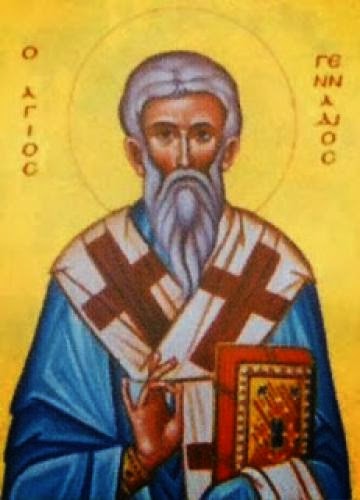
St. Gennadius I, Patriarch of Constantinople (Feast Day - November 17)
By Protopresbyter Fr. George Papavarnavas
Saint Gennadius lived in the fifth century. He was a Presbyter of the Great Church of Christ and was elected Patriarch of Constantinople-New Rome in 458. He worked zealously to preserve the Orthodox Faith from heresies that threatened to alter it, and he even managed the return of many heretics back to Orthodoxy. Also, due to his office, he helped Patriarch Martyrius, who was evicted improperly and illegally by Peter the Fuller, to regain his throne.
Saint Gennadius, as noted in the sacred Synaxarion, arranged with great care for the training of the sacred Clergy, and he denied the ordination of any candidate that did not study the Psalter and knew how to interpret them. At this point we should note that at that time, according to prevailing custom, the candidate for the Clergy would be familiar with the Psalms of David and their interpretation. Also, he struggled with all his strength to combat the phenomenon of simony, in which money was made by ordinations, which was common in those days. For this reason he convened a Synod in Constantinople, and sent out an encyclical "Against the Buying of Ordinations".
He reposed in the year 471. The end of his life was peaceful.
His life and times give us the opportunity to emphasize the following:
In olden times the faithful gave great importance to the reading of the Book of Psalms, and spiritual fathers especially urged their spiritual children to read them every day, because the reading of the Psalter is not only a way to pray, but it creates inspiration which is necessary for spiritual progress, but also for the work of everyday life. The Athonite services are interspersed with readings from the Psalter, and exude a unique spiritual flavor.
At the beginning of the Book of Psalms there is written, among other things, the following verses which declare in a poetic way the content of the Psalter, and the beneficial effects of frequent use:
Be silent, Orpheus; thy lyre throw aside, O Hermes.The tripod at Delphi hath sunk into oblivion for evermore.For us David doth now play the Spirit's lyre,The hidden things of God's mysteries he revealeth;A multitude of ancient wonders he narrateth;Of the Creator of creation, doth he move one to sing.Saving all those men he initiateth, as he writeth his verses,Sinners doth he bring to desire repentance.Among other teachings, to the throng doth he declare the Judge's judgments.The purging, he doth teach, of soulful sinnings.*
and
Psalter of David, whose words are like stones,You crush another Goliath, the passions.
The psalter was "a musical instrument with ten strings. It stood upright and even, and the cause and occasion of the notes were received from the top." According to Basil the Great, "this is the difference between a psalter and a harp; the sound of a harp is produced from its bottom, while that of the psalter is from the top." The psalter as a musical instrument existed before David, but David went from using it "as an amateur for the private use of gathering his sheep into the fold, to building it up and associating it in a most technical way." The Book of the Psalms of David also came to be called the Psalter because, as Basil the Great says: "Though many musical instruments exist, the Prophet David used the psalter for the Book of Psalms." He continues saying: "I believe he did this to show the Grace of the Holy Spirit, which comes down from above, like the musical instrument whose notes come from the top."
The Book of Psalms is similar in some ways to a ladder, which bring man from the lower to the higher and gradually prepare him to meet God. The Jews divided the Book of Psalms into five sections, namely: 1) Psalm 1-40, 2) 41-71, 3) 72-88, 4) 89-105, 5) 106-150 [LXX rendering]. This division is connected with theoretical ascent, according to Saint Gregory of Nyssa, who says the following remarkable things:
A) "The first section helps man to move away from evil, which is why it begins: 'Blessed is the man who walks not in the counsel of the ungodly, nor stands in the path of sinners, nor sits in the seat of the scornful'."
B) The second section helps man thirst for the good and seek it as a thirsty deer seeks for water, which is why it begins with the Psalm that says: "As the deer thirsts for streams of water, so my soul thirsts for You my God."
C) The third section makes man a visionary of the nature of things, which is why it begins: "Truly God is good to Israel, to such as are pure in heart" and "I was like a beast before You". That is, I considered as good the transient things of this life. Now, however, that I have taken hold of the incorruptible and invisible, I am with You.
D) The fourth section does not allow a person to be common, but it unites us with god and makes us people of God, which is why the 89th Psalm begins thus: "The prayer of Moses, the man of God."
E) The fifth section raises the person to the highest part of the ascent, where the fullness of human salvation is found. "Let everything that has breath praise the Lord", is the last verse of the Psalter.
From everything noted above we can surmise how much benefit accrues to the person who loves to pray with the Book of Psalms, which in the first Christian centuries, as we saw, was used daily, and even its knowledge and interpretation was considered a prerequisite for entrance to the Clergy.
* "THE PSALTER ACCORDING TO THE SEVENTY OF DAVID THE PROPHET AND KING", HOLY TRANSFIGURATION MONASTERY, BROOKLINE, MASSACHUSETTS, 1974, P. 21. READ ALSO "THE 'LINES TO THE DIVINE DAVID' AND THE FIRST PRINTED ROMANIAN BIBLE (1688)" BY EMANUEL CONTAC.
Source: "Ekklesiastiki Paremvasi", ". ", November 2009. Translated by John Sanidopoulos.